 Bureau case file88% confidence
The brass thing in the biscuit tin
Surveyor's pocket aneroid altimeter
Everyone said clock. It measured mountains.
This illustrative case began, as such things often do, in a biscuit tin during a Leeds house clearance. Its finder took the compact brass mechanism for a broken clock: there is a dial, a central hand or spindle, a circular case and a general air of something that ought to have sat on a mantelpiece. The assumption was reasonable only at first glance. The scale engraving, and the serial sequence associated with the maker, point instead to a portable surveying instrument.
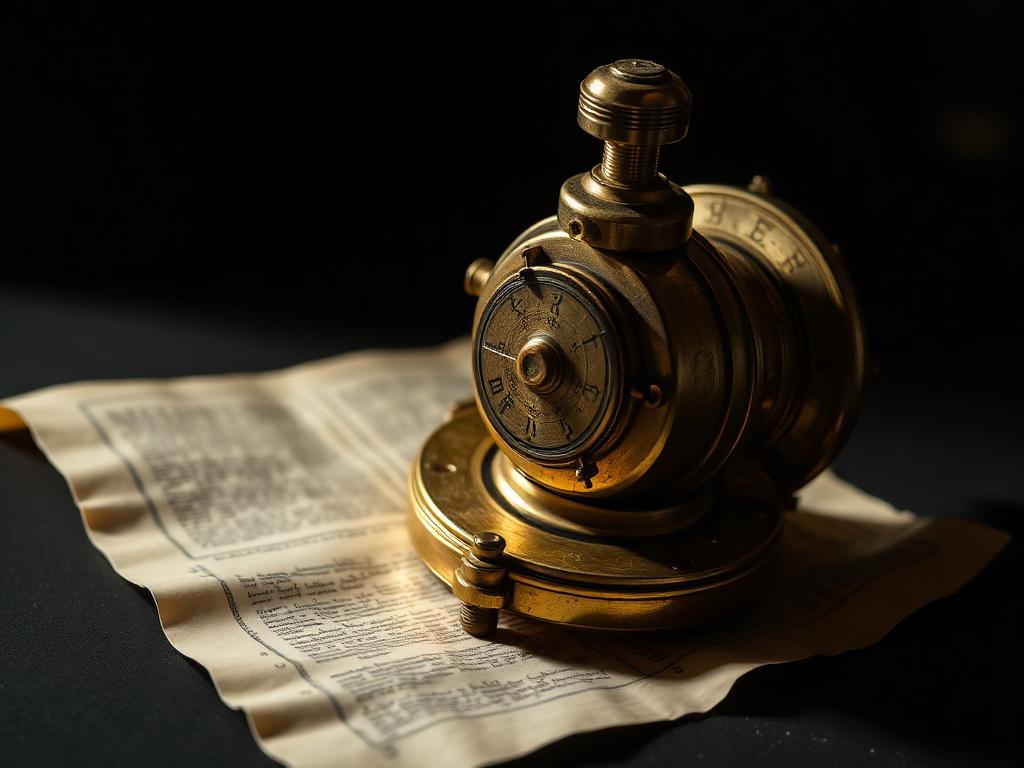
The photographed object is a substantial, circular brass instrument on a broad, stepped base. Its case is built from several concentric sections, with a darkened seam around the principal body and small screws or fasteners visible at the front. A small circular dial faces forward, protected by a raised rim. Its surface appears aged and unevenly darkened, with fine engraved divisions and Roman-numeral-like markings visible around the perimeter. Above the body is a threaded vertical stem carrying a knurled, domed adjustment knob. A second, partly obscured graduated ring or dial is visible behind the main casing.
The finish is not the clean, lacquered brass of a recently polished decorative piece. It shows tarnish, rubbed high points and darker material collected in seams, around the dial rim and at the base. These are consistent with age and handling, though a photograph cannot establish whether every mark is original rather than later wear. The construction is plainly functional: screw-fixed plates, threaded adjustment, graduated components and a low base intended to keep the instrument stable while a reading was taken. No readable maker's name, serial number or scale wording can safely be transcribed from this image.
A clock was the obvious false lead, but the exposed adjusting stem and the apparent graduated secondary ring do not suit an ordinary domestic timepiece. Nor does the heavy, instrument-like base. A pressure gauge or steam fitting might account for brass and a dial, but would more usually present a single clear pressure scale and a pipe connection rather than this compact, enclosed arrangement with fine adjustment. A surveying compass was also considered, yet the photographed front appears to be a mechanically read dial rather than a freely suspended compass card. The stated engraved scale is the decisive feature: altitude, rather than hours or pressure alone, is what changes the classification.
The most likely identification is a surveyor's pocket aneroid altimeter, confidence 88%. Aneroid altimeters use changes in atmospheric pressure to indicate height above a reference level. Internally, a partially evacuated metal capsule expands or contracts with pressure changes; a linkage transfers that movement to a pointer and calibrated scale. The external adjustment permits the user to set a reference pressure or known elevation before a traverse. The visible casework is more elaborate than that of a simple pocket watch-type barometer, but it remains consistent with a robust field instrument intended for repeated setting and reading.
In Britain around the turn of the twentieth century, such instruments were useful where approximate relative heights mattered: estate and civil surveys, route reconnaissance, mining and quarry work, hill walking, military mapping and exploratory fieldwork. They did not replace levelling instruments where precision was required. Weather affects barometric pressure as well as elevation, and conscientious users compared readings with a known station or repeatedly reset the instrument. That practical limitation explains the emphasis on adjustment and scale work rather than clockwork display.
The proposed date of c. 1890–1910 is supported by the brass, screw-built construction, engraved analogue presentation and generally Victorian-to-Edwardian engineering character. The United Kingdom attribution rests chiefly on the reported maker's serial run and the stated provenance rather than on any legible inscription in the photograph. Serial sequences can be useful when they are matched against catalogues, surviving instruments or maker records, but they should not be treated as proof unless the number and maker's name are clearly recorded. The Leeds clearance explains where this example surfaced, not necessarily where it was originally used.
Confirmation beyond doubt would require sharp photographs of the entire scale, the maker's mark, serial number, any patent wording, and the back or underside; ideally, the case would be opened only by an instrument specialist to inspect the aneroid capsule and linkage. A comparison with period British makers' catalogues could then establish model, date range and whether the base or fittings are original. In worn, untested condition, a comparable anonymous or partly marked example might bring roughly £80–£200. A clearly signed, complete, working and documented survey instrument can exceed that range, while damage to the capsule, missing glass or illegible markings would reduce it sharply.
Illustrative bureau case study — prepared by the Object Detective bureau.
Share the case
Anyone with this link sees the evidence, timeline and verdict — no account needed.
https://objectdetective.app/mysteries/showcase/f0bb5c83-5562-4818-8394-1a98813c2d97?v=20260903
Facebook: tap Facebook to copy the link, then Open Facebook and paste it into a new post. TikTok and Instagram copy the link for you to paste in-app.
Case notes from the bureau
Add the first note
Members can add what they recognise, correct the record, or leave a lead for the next investigator.
Members only — sign in to add a note or back one.
Sign in