 Bureau case file82% confidence
The hook nobody could name
Hay-bale hook, forged by a regional smith
Three worn letters. One forge. Case closed.
It surfaced, in the usual way, without a name attached: a heavy iron implement set aside from a shed clearance because no one could account for the hooked end or the curious plate at the other. The first impression was of a purpose-built agricultural tool rather than an improvised hook. Its working surfaces have been used hard, but not altered beyond recognition.
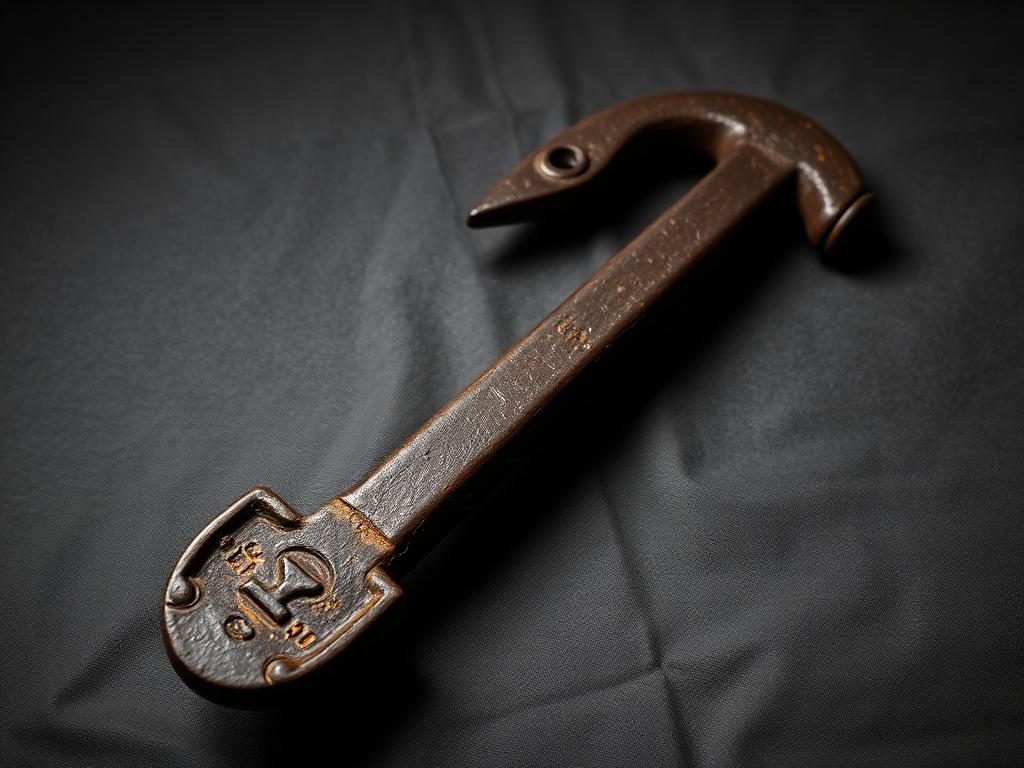
The photograph shows a dark, rust-brown forged iron piece with a long, flat rectangular shank, broadening into a compact hooked head. The hook is thick in section, turns back in a tight curve, and terminates in a blunt, slightly flared stop rather than a sharp point. Beneath the curve is a projecting beak with a circular, metal-lined eye. At the opposite end, the shank enters a rounded plate or fitting with raised decorative or maker-related forms and several small circular fasteners or rivet heads.
Wear is concentrated where one would expect it: along the outer sweep of the hook, on the beaked projection, and across the face of the shank. The metal retains a pitted, old oxidised surface, with brighter rubbed edges where repeated handling or contact has removed the darker scale. The fitting at the lower end appears integral to the tool’s original construction rather than a recent repair. It suggests an attachment point or a deliberately engineered grip arrangement, not a simple hand-forged crook.
A butcher’s hook, boat hook and general lifting hook were considered first, then set aside. A butcher’s pattern normally favours a sharper penetrating point; this one is made to catch and hold rather than pierce. A boat hook would usually carry a longer shaft and a more open, utility-shaped hook. The stout flat shank, closed curve, and eye-like fitting are better explained by a tool intended to engage a rope, strap or bale binding under load.
The identification is a hay-bale hook, forged by a regional smith. Such hooks were used in handling bound hay, commonly by catching bale ties or by taking purchase at the bale rather than spearing deeply into its contents. The worn stamp on the shank was nearly lost to oxidation and use. Under raking light, three surviving letters were sufficient to connect the mark with a regional forge pattern, while the hook’s particular construction supported the attribution.
This is a product of the period when farms increasingly moved and stored hay in compact tied bales, yet still relied on hand labour, carts and simple lifting arrangements. A hook of this weight could assist one person in dragging, steadying or loading bales, especially in sheds, yards and lofts. Its restrained ornament at the handle or attachment end is a useful reminder that rural tools were often made by local smiths with recognisable workshop habits rather than to anonymous factory patterns.
The proposed date of about 1860–1900 rests on the forged construction, the mature agricultural form, the aged finish and the maker’s stamp rather than on a single decisive feature visible in the photograph. Ireland is the most likely origin on the present evidence, subject to the stamp reading. Confirmation beyond doubt would require a close, high-resolution examination of the surviving letters, measurements, and comparison with catalogues, marked examples or records from the suspected forge. In this condition, it is principally a sound, attributable agricultural curiosity rather than a rare decorative object: roughly £40–£90, with a securely documented maker potentially improving that figure.
Illustrative bureau case study — prepared by the Object Detective bureau.
Share the case
Anyone with this link sees the evidence, timeline and verdict — no account needed.
https://objectdetective.app/mysteries/showcase/eb5221d7-f380-46e6-a44a-e99c7df1c3de?v=20260903
Facebook: tap Facebook to copy the link, then Open Facebook and paste it into a new post. TikTok and Instagram copy the link for you to paste in-app.
Case notes from the bureau
Add the first note
Members can add what they recognise, correct the record, or leave a lead for the next investigator.
Members only — sign in to add a note or back one.
Sign in