 Bureau case file68% confidence
The box with a false bottom
Cased instrument box, repurposed as a document box
The panel slid. Something used to live in there.
The box surfaced in the usual unhelpful state: an attic survivor, darkened by storage and already serving a different purpose. It had been kept as a document box, its plain rectangular cavity apparently sufficient for papers. The difficulty lay in the loose, pale timber panel found within or alongside it. Once recognised as a fitted part rather than an incidental board, it altered the reading of the whole object.
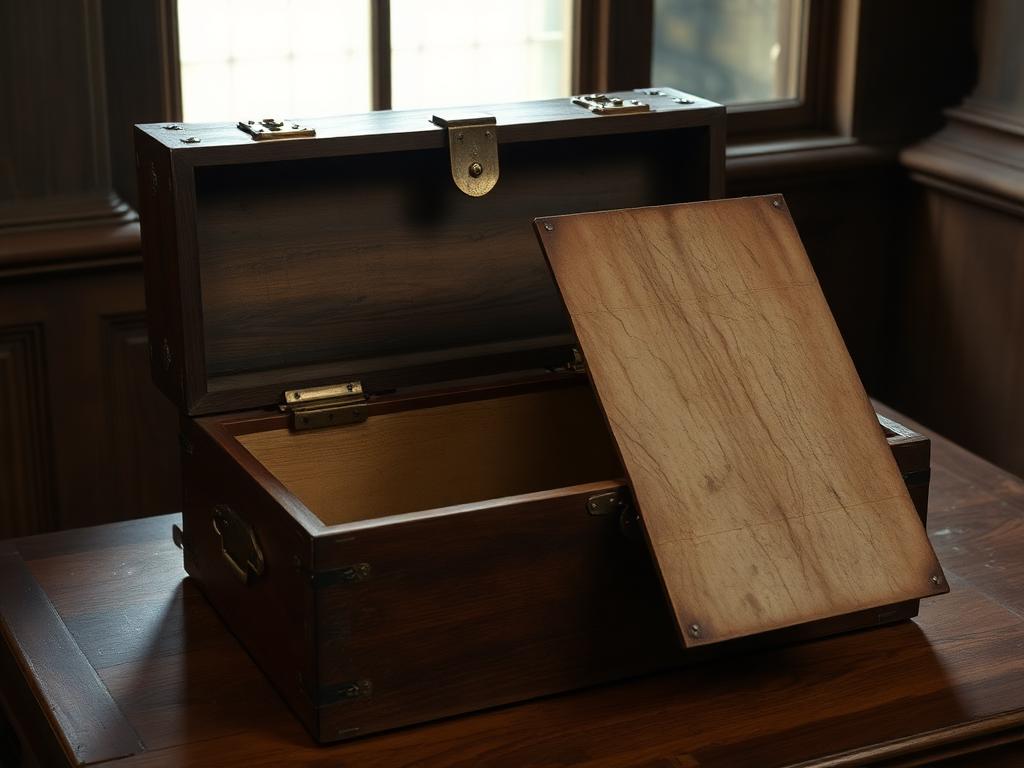
The photograph shows a compact, dark-stained wooden case with a hinged, upright lid, brass-coloured hinges and a central hasp or lock plate. The lid is broad and flat inside, without pockets, straps or labels visible. The lower section is deep, box-like and open, with a narrow internal ledge or rebate around its upper edge. Metal corner fittings are visible at the front lower corners, and a recessed circular metal fitting appears on the left side, perhaps a carry handle or escutcheon. The timber has scuffs at edges and fittings, a softened sheen from handling, and small areas of surface wear consistent with long use.
Most telling is the removable panel, shown propped against the case. It is a lighter, figured board with a dark retaining strip or edge at its lower end and small screws set near the corners. Its dimensions appear calculated for the interior rather than for use as a lid: it is too slight and too plainly finished to be the principal cover, while the rebate inside the box gives it an obvious seating place. The arrangement supports a false or raised bottom, creating a shallow concealed or protected compartment beneath the main contents.
A conventional writing slope, a travelling dispatch box and a cash box were considered. The photograph does not show the divided tray, pen recesses, correspondence racks or sloping writing surface expected in a writing box. Nor are there the tills, coin divisions or more substantial lock arrangements usually associated with a cash box. A document box remains a fair description of its later function, but not its first one: the fitted board and otherwise unusually plain interior suggest that it was designed around a particular object or set of components, later removed.
The most likely identification is a cased instrument box, subsequently repurposed for documents. Instrument cases commonly used fitted interiors, removable packing boards and false bottoms to steady delicate equipment, protect accessories, or separate a principal instrument from small parts. With the original contents gone, the surviving case can appear frustratingly generic. Here, however, the purpose-made panel, deep lower cavity, protective metal fittings and carrying provision point to a portable case intended for more than loose papers.
In Britain between roughly 1880 and 1920, cases of this type accompanied scientific, surveying, optical, technical and professional instruments, as well as certain specialist tools. Their interiors were often tailored in felt, baize, leather or timber partitions; when those fittings were removed, worn out or deliberately cleared, a useful lockable box remained. Such cases were routinely retained in households and offices, where their solid construction made them convenient for deeds, letters and private papers. The false bottom could then acquire a more dramatic reputation than its original practical role deserved.
The date is based on the restrained rectilinear form, dark hardwood-like finish, exposed brass-coloured hardware and protective corner mounts, all compatible with late Victorian to early twentieth-century British portable cases. The photograph does not show a maker's plaque, lock stamp, trade label or railway label, so the United Kingdom attribution remains probable rather than conclusive. The stated confidence of 68% is appropriate: the construction identifies a class of object more securely than it identifies the exact instrument once housed there.
Confirmation would require close inspection of the underside of the panel, the base compartment, hinge leaves, lock plate and any concealed labels or stamped marks. Ghost outlines from former partitions, felt traces, screw holes or an instrument maker's name could narrow the original contents considerably. As an empty, altered cased instrument box, a rough working value would usually be in the region of £80–£200, condition and dimensions permitting. A named maker, an identifiable surviving fitted interior, or evidence tying it to a particular instrument could raise that materially; absent those, its interest lies chiefly in the case and the concealed layer it retained.
Illustrative bureau case study — prepared by the Object Detective bureau.
Share the case
Anyone with this link sees the evidence, timeline and verdict — no account needed.
https://objectdetective.app/mysteries/showcase/e5acad7a-7ad0-4eb5-95d2-a1a086f808e3?v=20260903
Facebook: tap Facebook to copy the link, then Open Facebook and paste it into a new post. TikTok and Instagram copy the link for you to paste in-app.
Case notes from the bureau
Add the first note
Members can add what they recognise, correct the record, or leave a lead for the next investigator.
Members only — sign in to add a note or back one.
Sign in