 Bureau case file71% confidence
The locket with the wrong date
Mourning locket, silver, with tintype portrait
The initials belonged to somebody else entirely.
This illustrative bureau case began with a family locket whose ownership trail had become unhelpful rather than informative. It had been kept as a mourning piece, yet the initials said not to belong to the family then holding it, and the date written beneath the portrait appeared to offer an answer while creating a larger difficulty. The object was photographed open, which matters: its evidence lies not in a decorative exterior but in the small, private arrangement preserved inside.
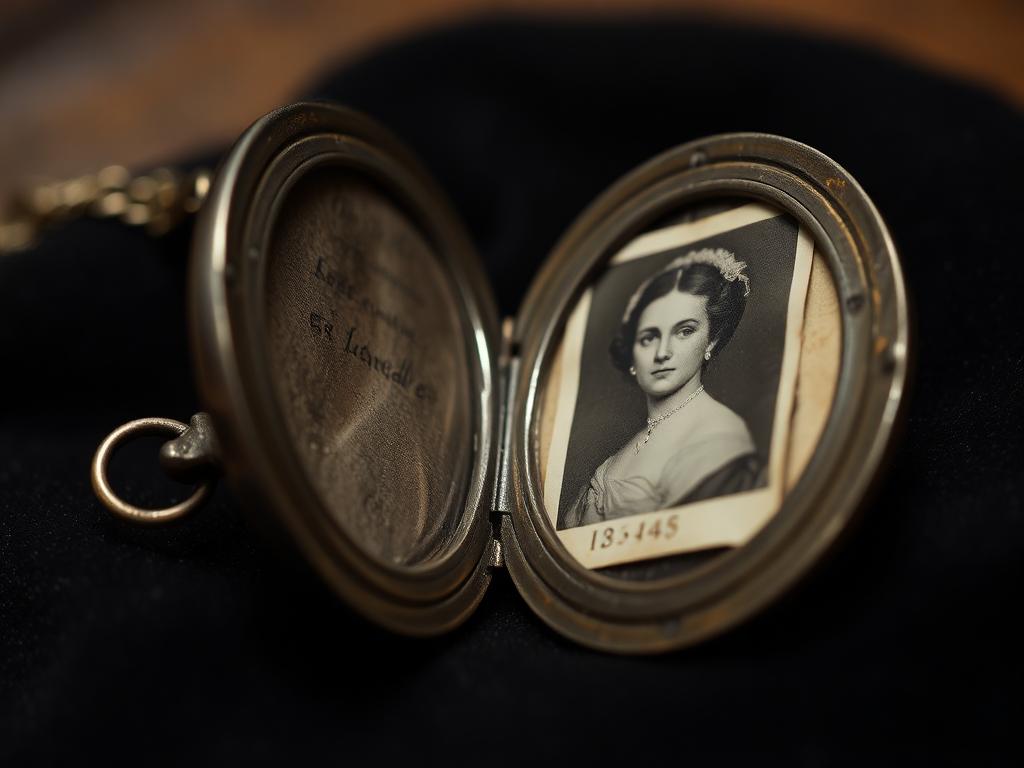
What is visible is an oval, hinged locket in a pale, tarnished metal consistent with silver. It has a substantial raised rim around each half, a simple suspension loop at one end, and a hinge opposite it. The surfaces show softened edges, darkened recesses and small areas of uneven wear, all compatible with long handling. The interior is fitted rather than merely used as a loose container: the portrait sits behind a narrow retaining rim, with pale paper or card packing visible around it.
The right-hand compartment holds a black-and-white photographic portrait of a young woman, cut to the oval interior but retained with a rectangular lower margin. She wears a formal off-the-shoulder dress, jewellery and an elaborate, centrally parted hairstyle. A handwritten or inscribed number, apparently "13:145", is visible on the lower border. It should not be treated automatically as a date. Its punctuation and placement are at least as suggestive of a studio, negative, sitter or inventory reference as of a day and year.
The opposite half contains a faded textile-backed panel or lining, on which dark initials and further indistinct writing can be seen. Their exact reading cannot safely be taken from this photograph, but the contrast between those marks and the later family attribution is the central problem of the case. A lock of hair, a painted miniature and a modern printed snapshot were considered as possible contents or comparanda. None fits the visible photographic image as well as an early direct-positive portrait, and the object shows no obvious provision for a hair compartment in the view provided.
The most defensible identification is therefore a silver mourning locket containing a tintype portrait, probably assembled or adapted as a personal memorial jewel. The image has the dark, direct-positive appearance associated with tintypes, rather than the warmer, more reflective look often expected of an ambrotype or the fine paper surface of a later cabinet card. The black presentation, close cropping and small scale are particularly persuasive, although a physical examination would be needed to distinguish the metal photographic plate beyond doubt.
Mourning lockets were intimate objects: worn close to the body, kept with a portrait, hair, inscription or other token of a dead relation or friend. They did not always record death at the moment it occurred. A portrait could be made during life and mounted later; a locket could be inherited, re-used, or stocked by a jeweller before its final inscription. That sequence offers a sober explanation for apparently mismatched initials. The locket may memorialise the woman pictured, while the written marks preserve another stage in the object’s history rather than the identity expected by its later owners.
The c. 1855–1875 date is supported chiefly by the tintype process and the sitter’s dress and hair, rather than by the misleading number on the mount. Tintypes became widely available in the United States from the later 1850s and were especially suited to inexpensive, portable portraits for lockets and other personal keepsakes. The locket’s plain oval construction and restrained silver finish are compatible with that period. American origin is plausible through the photographic format and proposed date range, but no maker’s stamp, assay mark or place mark is visible in the supplied view.
Confirmation would require the locket to be examined in hand: the interior should be checked for hallmarks, retailer marks, a maker’s stamp, and evidence that the photograph is a japanned iron tintype plate rather than a paper print. The obscured initials and writing should be read under raking light, and the number beneath the portrait compared with period studio conventions. Value is necessarily modest without a named maker, proven sitter or documented provenance: a plain nineteenth-century silver mourning locket with a period portrait might broadly fall around £150–£400 at retail, with stronger value if the marks, identity or history can be securely established.
Illustrative bureau case study — prepared by the Object Detective bureau.
Share the case
Anyone with this link sees the evidence, timeline and verdict — no account needed.
https://objectdetective.app/mysteries/showcase/98b31139-9856-4492-9f9b-6a6f1e986013?v=20260903
Facebook: tap Facebook to copy the link, then Open Facebook and paste it into a new post. TikTok and Instagram copy the link for you to paste in-app.
Case notes from the bureau
Add the first note
Members can add what they recognise, correct the record, or leave a lead for the next investigator.
Members only — sign in to add a note or back one.
Sign in