 Bureau case file79% confidence
Two badges from the mud
Trench art brooch made from cap-badge components
Not a regimental badge. Something far more personal.
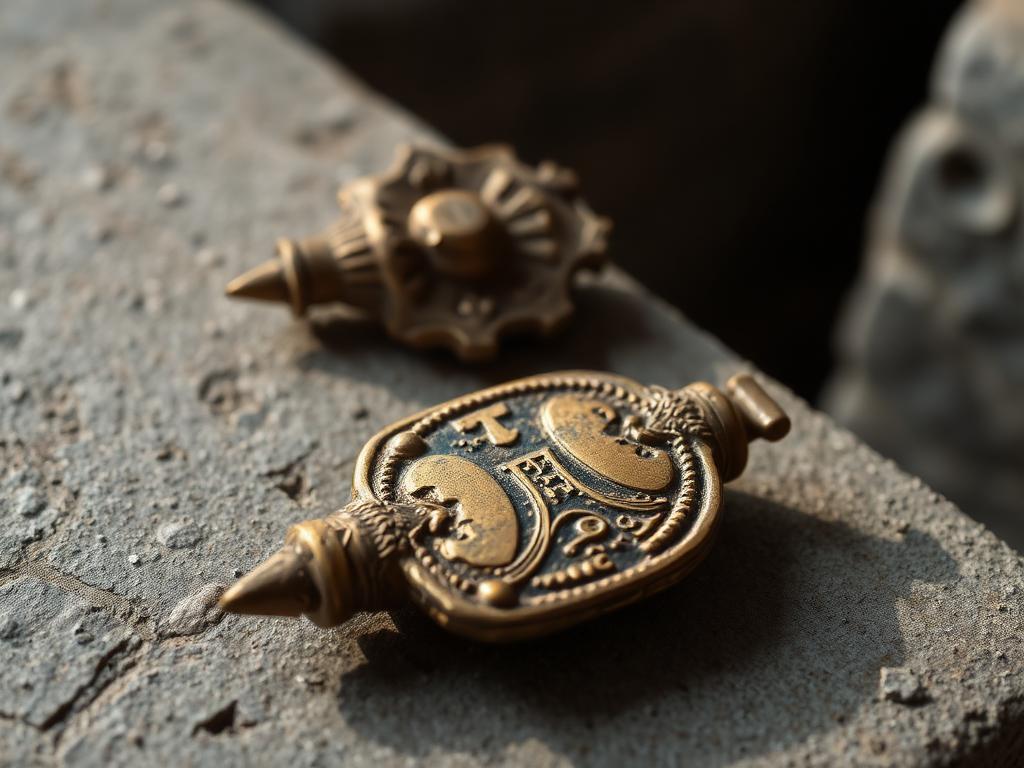
The object is presented as having been recovered by metal detector from farmland, a setting entirely consistent with small personal metalwork displaced by cultivation and buried in heavy ground. What survives in the photograph is not a complete issue badge in any conventional sense. It is a compact, deliberately assembled ornament, photographed against mud-marked stone or soil, with a second, related-looking component lying behind it.
The foremost piece is warm yellow-brown metal, probably brass or a brass-rich alloy, with dirt lodged in recesses and wear to the raised decoration. Its principal body is a rounded, shield-like plate enclosed by a beaded border. Within it are two opposed crescent or scroll forms, divided by a narrow vertical element carrying small raised lettering or marks that cannot be read reliably from the image. The surface has the unevenness of relief stamping and subsequent handling rather than a newly cast, uniform finish.
At either side of this plate are prominent pointed fittings resembling conical studs or finials, each joined by short, ribbed collars. At the upper right sits a further small coiled or knopped fitting. These parts do not read as the normal lugs, slider or pin arrangement expected on an intact cap badge. Their placement is ornamental and asymmetrical enough to suggest that existing badge elements have been cut, bent or otherwise repurposed into a brooch-like piece.
The blurred object behind reinforces that reading. It appears to include another stamped metal badge or decorative plate, with a central domed boss and radiating or toothed outline, alongside a similar pointed fitting. Although too out of focus for a safe reading of its design, it supports the supplied description of an object assembled from two badge components, rather than one standard regimental insignia. No readable regimental title, crown, number or maker's stamp is visible in the photograph.
A conventional cap badge was considered but ruled out as the complete identification: the composite construction, added-looking finials and lack of a recognisable standard mounting are wrong for a badge intended to be fixed directly to headgear. A modern fantasy military jewel is also less persuasive, since the metal has embedded soil, softened high points and a construction language consistent with salvaged stamped fittings. The closest identification is trench art: a hand-made keepsake or brooch fashioned from military badge components.
Such work was made by servicemen and, at times, by people close to the camps and battle zones, using accessible uniform hardware, cartridge brass and other scrap. Pieces could serve as souvenirs, gifts or private mementoes rather than official insignia. The appeal lies precisely in the alteration: two objects made to identify a unit or wearer have been turned into a small personal ornament, with usefulness and symbolism taking precedence over regulation.
The proposed date of about 1915–1918 fits the material, the use of military badge elements and the trench-art tradition associated with the First World War. France is a reasonable country of origin or recovery context given the farmland find and the scale of wartime activity there, but the photograph alone cannot establish where it was made. The 79% confidence reflects a strong visual case for a period composite brooch, while leaving the original badges and precise workshop or maker unidentified.
Beyond doubt would require clear photographs of both faces, measurements, metal analysis and close inspection for cut edges, solder, altered lugs, pin hardware and any stamped marks. Comparison of the visible motifs with documented First World War cap badges might identify the donor components. Value is modestly collector-led rather than precious-metal-led: an unattributed but convincing example might roughly fall in the £40–£120 range, with a secure badge attribution, intact fastening and recorded lawful provenance capable of raising it.
Illustrative bureau case study — prepared by the Object Detective bureau.
Share the case
Anyone with this link sees the evidence, timeline and verdict — no account needed.
https://objectdetective.app/mysteries/showcase/0907f0c5-b882-4ddb-b930-dd01c12f9b46?v=20260903
Facebook: tap Facebook to copy the link, then Open Facebook and paste it into a new post. TikTok and Instagram copy the link for you to paste in-app.
Case notes from the bureau
Add the first note
Members can add what they recognise, correct the record, or leave a lead for the next investigator.
Members only — sign in to add a note or back one.
Sign in